
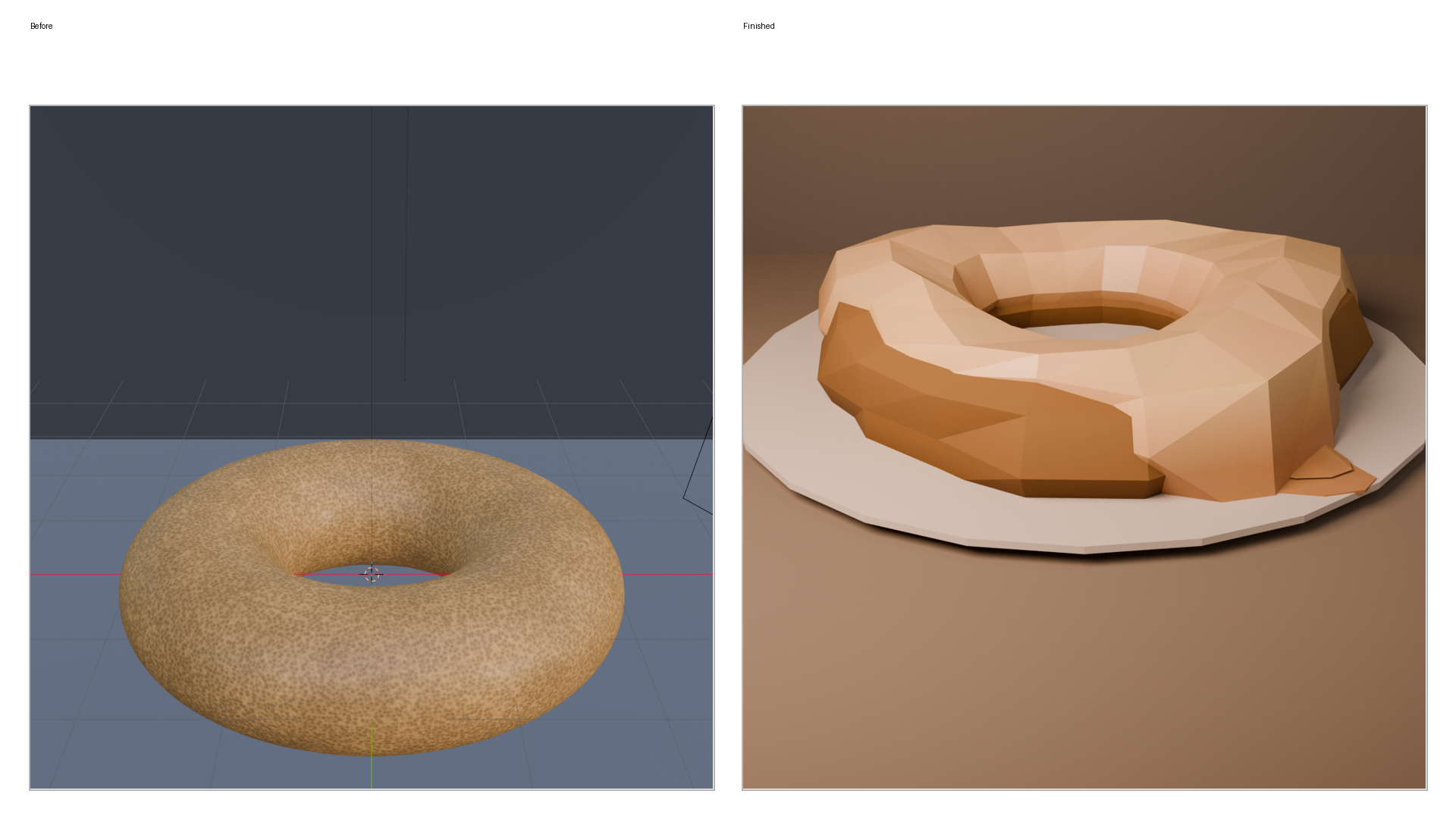
What I like about this pair of images is how clearly they show the real path of the work.
The first image is still honest about where the project began. The doughnut had the right overall form and a believable baked surface, but it was still a working model. It lived in the viewport, not in a scene. There was no final presentation around it yet, no plate, no icing story yet.
Getting from that point to the finished version was not one big leap. It was a stack of smaller corrections.
First came the surface and shape work. The base needed enough irregularity to feel like food rather than a perfect torus. After that, the focus shifted to the glaze. That turned into the real centre of the process. The icing had to feel placed, not procedural. It needed weight, flow, and a silhouette that made sense from the camera angle.
A lot of the progress came from iteration rather than invention. Render, inspect, adjust. Change the icing edge. Check how it meets the dough. Fix the drips. Pull it back when it gets too neat. Push it again when it looks too separate. The finished image is really the result of repeated small judgements.
Presentation mattered just as much as modelling. Once the doughnut moved onto the plate and into a cleaner lighting setup, the project stopped reading like a material study and started reading like an image. That shift is easy to underestimate. A model can be technically improved and still not feel finished until the scene around it supports it.
The toolchain here was simple and open where possible: Blender for the modelling, material work, lighting, and rendering, plus a very iterative review loop to compare passes and decide what was actually improving the image. Most of the work was not adding complexity. It was deciding what to keep, what to remove, and what needed one more pass.
That is how we got here: not by chasing perfection in one move, but by letting the doughnut slowly become more convincing with each correction.